
Παρασκευή 14 Ιανουαρίου 2011

Πέμπτη 13 Ιανουαρίου 2011

Τετάρτη 12 Ιανουαρίου 2011
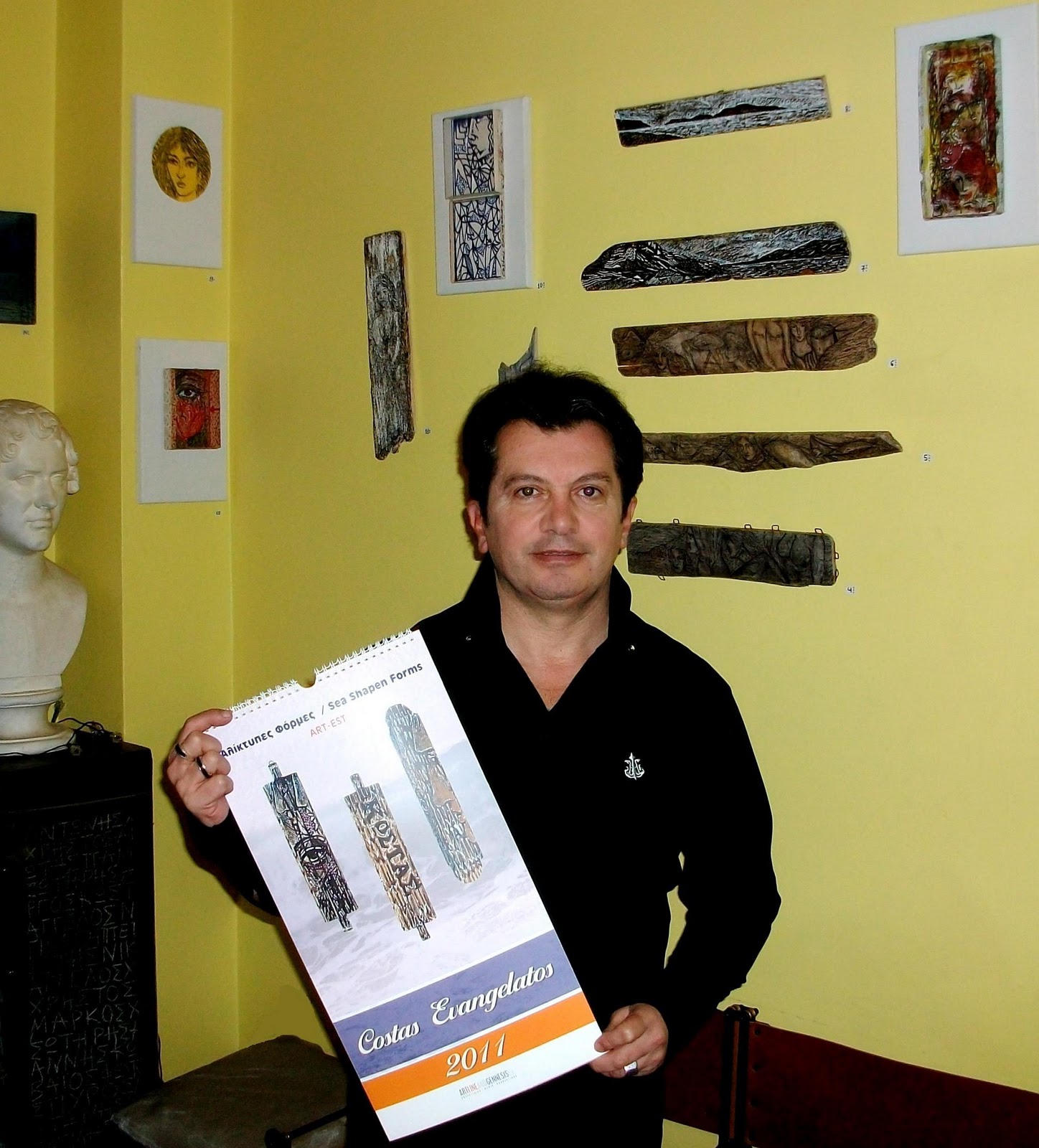
ΗΜΕΡΟΛΟΓΙΟ ART-EST 2011 TOΥ ΚΩΣΤΑ ΕΥΑΓΓΕΛΑΤΟΥ/ΚΡΙΤΙΚΗ ΛΕΟΝΤΙΟΥ ΠΕΤΜΕΖΑ
Κείμενο κριτικής για τις Αλίκτυπες φόρμες στο εικαστικό ημερολόγιο 2011 του Κώστα Ευαγγελάτου από τον ιστορικό τέχνης Λεόντιο Πετμεζά.
Η επεξεργασία του ξύλου από τον εικαστικό δημιουργό Κώστα Ευαγγελάτο δίνει
σάρκα και οστά σε ένα φθαρμένο υλικό ,το οποίο μεταλάσσεται με εντεχνο τρόπο σε προιόν αυτούσιου ζωγραφικού πίνακα. Η ιδιάζουσα τέχνη του σ’ αυτή τη περίπτωση εμπεριέχει την συνέχεια των ιδεογραμμικών συλλήψεων με τις οποίες έχει ασχοληθεί στο παρελθόν και προδιαθέτει τη συνύπαρξη μιας κατάστασης με ευρύ φάσμα ζωτικότητας που αποκαλυπτικά ενυπάρχει στη συμπαντική αρμονία. Οι συνθέσεις του φετινού ημερολογίου συλλογικά περιγράφουν φαινόμενα φύσης με μουσικότητα ,μορφές σε γήινο και ανθρώπινο επίπεδο ,προβάλλοντας την ανάπτυξη μιας θεωρίας στην οποία το αποτέλεσμα των προθέσεων και της διαπραγμάτευσης είναι ένα σημαντικό βήμα διεπιστημονικού διαλόγου για μιά αναλυτικότερη περιγραφή. Η προοπτική γίνεται μέσω πολλαπλών προσεγγίσεων: της κοσμολογίας που εμφορείται από τη βιολογία και την ανθρωπολογία , της φιλολογίας που εμπεριέχεται στη φυσική και της φιλοσοφίας που ενέχει η ψυχολογία. Πρόκειται για ένα αρχέτυπο μοτίβο που αποδίδει κάθε ιδανικό που περικλείει την έννοια του ενδεικτικού κάλλους και φτάνει σε διδάγματα τεχνικής . Το μεγαλείο της αναφοράς του καλλιτέχνη εμφορείται από αξίες που ξεπερνούν την επιφάνεια γραφής και αντιπαρατίθενται δυναμικά στη έμπνευση των συνειρμικών συσχετισμών. Η διαφοροποίηση ενσωματώνει στην εικόνα της υποδοχής την τελική συνεικόνα και δίνει προτεραιότητα στη απορρέουσα χρωστική ουσία.
Η επιστρωμάτωση του ξύλου με σχεδιαστική αποτύπωση επιτελείται βαθμιαία όχι τόσο μέσω του χρώματος αλλά με την επικράτηση του σχεδίου ,που συντελεί κύρια στη σταθεροποίηση της άποψης για τη βαρύτητα της ιδιαιτερότητας.
Το είδος των συντιθέμενων υλικών επιτρέπουν εδώ την αφαίρεση του κύριου όγκου της προηγούμενης μορφής από την διάθεση των στοιχείων. Οι νέες εξεικονίσεις αντιπαρατίθενται στη φθορά και φτάνουν ως όραμα κοντά σε κάθε θεατή, ενώ με φόρτιση απαιτούν τη νοητική διεργασία που χρειάζεται για να τις ενστερνιστεί το κοινό. Πέρα από τη φάση της πρώτης επισήμανσης γίνονται σταθερός προσανατολισμός στη διαδικασία διαβάσματος της εικαστικής ανατροπής του καλλιτέχνη.
Ο Κώστας Ευαγγελάτος είναι ο σύγχρονος δημιουργός που εκδίδει κάθε χρόνο ένα ημερολόγιο-παρακείμενο της παρουσίας του στα δρώμενα της τέχνης ,με αρκετά νεωτεριστικό και εκλεκτιστικό ρυθμό στην απόδοση των επιτευγμάτων του. Αποθησαυρίζει τον εικαστικό εαυτό του, θέτοντας τον σε μια περιοχή,όπου κυριαρχεί ευπρόσδεκτα η σχέση μεταξύ σημαίνοντος και σημαινόμενου ,χωρίς να υπερτερεί το ένα έναντι του άλλου αλλά θέτοντας τα να συμβαδίζουν σε μια αγαστή συνεργασία για την ευόδωση του πλέον θετικού για την τέχνη αισθητικού αποτελέσματος.
ΛΕΟΝΤΙΟΣ ΠΕΤΜΕΖΑΣ
Ιστορικός τέχνης

Τρίτη 11 Ιανουαρίου 2011
ΜΟΥΣΕΙΟ Γ.ΓΟΥΝΑΡΟΠΟΥΛΟΥ (G.GOUNARO),ΑΝΩ ΙΛΙΣΙΑ

G. GOUNARO
Δ/νση: Γουναροπούλου 6, ¢Ανω Ιλίσια Τ.Κ. 157 71
Τηλ: 210 74 87 657- 210 77 77 601 fax: 210 74 87 657
e-mail: info@gounaropoulos.gr
Με αφορμή την Έκθεση Γλυπτικής της Μαρίας Κ. Γκίζη – Γλυπτογράφου & Γλύπτριας netsuke,
με τίτλο: «...στη φθαρτή εφήμερη ύλη του κόσμου γλυστρώ
με το στιγμιαίο παρόν, ερωτοτροπώ!»
στις 19 Ιανουαρίου 2011 και ώρα 17.30, θα πραγματοποιηθεί εκδήλωση
με αφορμή την παρουσίαση του συλλεκτικού βιβλίου-λευκώματος
της έκθεσης των γλυπτών-εικόνων της Μαρίας Γκίζη.
Η παρουσίαση θα πλαισιωθεί από ομιλίες «Εικόνες ενός κόσμου εφήμερης χαράς»
από την ιστορικό Απωανατολικής Τέχνης, Δρα Κλαίρη Παπαπαύλου,
και «Πέστο μ’ένα haiku» από την ποιήτρια, Ζωή Σαβίνα.
ΠΑΡΑΤΑΣΗ ΤΗΣ ΕΚΘΕΣΗΣ ΜΕΧΡΙ 19 ΦΕΒΡΟΥΑΡΙΟΥ 2011
Δευτέρα 10 Ιανουαρίου 2011
ACG ART COLLECTION/ΤΟ ΠΟΡΤΡΑΙΤΟ ΤΟΥ ΠΟΙΗΤΗ ΑΡΙΣΤΟΤΕΛΗ ΝΙΚΟΛΑΙΔΗ
PORTRAIT OF POET ARISTOTELIS NIKOLAIDIS IN THE ACG ART COLLECTION
ACG Art welcomes 2011 with a significant donation of the Portrait of Poet Aristotelis Nikolaidis created in 1980 by PC1957 alumna Athena Politopoulou-Kargsten. This donation contributes to ACG Art's collection of portraits of significant authors, as varied as Archilochos; Honoré de Balzac; C.P. Cavafy; Alexandre Dumas; Odysseus Elytis; Rigas Fereos; Kimon Friar; Lafcadio Hearn; George Herbert; Homer; Nikos Karouzos; Nikos Kavvadias; Nikos Kazantzakis; General Yannis Makriyannis; Comte de Mirabeau; Benjamin Péret; Pandelis Prevelakis; Sylvia Plath; Yannis Ritsos; Marquis de Sade; George Sarandaris; Takis Sinopoulos; and Walt Whitman; as well as archetypal portraits of authors like in the work by Chôbunsai Eishi; Costas Evangelatos; and Alex Mylona.
Aristotelis Nikolaidis was born on 25 November 1922 in Mytilene, Lesbos Island, the son of doctor Theologis Nikolaidis from Serres and Konstantina, and brother of Nikos Nikolaidis, professor of psychoanalysis at the Université de Genève. During the German occupation he took part in the National Resistance, was persecuted, and was imprisoned by the British after 'the December events' of 1944 until the Varkiza Pact in 1945. After his release he served his military service - for three and a half years - as a reservist. He studied medicine at the National & Kapodistrian University of Athens, specializing in psychiatry and completed his doctoral dissertation in 1954 titled "The Depersonalization Syndrome". In 1954 he furthered his studies in Paris with a French government scholarship and until 1974 he traveled and lived in countries in Europe and North America by practising his profession as psychiatrist. As founder of the International Center for Scientific Terminology & Language of Athens (1966) and a founding member of the Greek Language Group, Nikolaidis also engaged with scientific scholarship and literature, working with newspapers, such as To Vima, Journal de Genève, Gazette de Lausanne, Frankfurter Allgemeine, News and magazines such as Elefthera Grammata, I Lexi, Kenourgia Epochi, Doma, Sections, Diavazo, etc. He married the painter Ingrid-Tilda in Paris, with whom he had a daughter, Maria. He died in 1996 in Athens.
Nikolaidis' first appearance in literature was in 1944 with the publication of the poem "Anatomy Lesson" in the magazine Student Art. In 1952 he published the poetry collection "Classifications", while turning to prose in the late '60s with the publication of the novel "The Co-Existing" in Montreal, Canada (1969). In 1976 he received the state award for fiction for his work in "The Disappearance". His works were translated into many foreign languages. The works of Nikolaidis are classified in the poetry of the '30s generation and are fundamentally characterized by his concern about the language and strength it gains when viewed as a value per se outside the conventional semantic framework and reveals influences from the philosophy of Freud and the literary movements of lettrism, existentialism and surrealism. His prose work, resulting of the creative effort in his mature age, falls in postwar fiction. It shares, however, the roots in his poetry, whose main feature is associative writing and the thematic orientation of the author's agony for the future of the world, a distressful state resulting mainly from the experience of the rebuttal of humanitarian ideals following the human adventure of the 2nd World War and the postwar years.
Athena Politopoulou-Kargsten met Nikolaidis in 1965 in an artistic circle that included Nikos Karouzos, Takis Sinopoulos and George Hadjimichael. Nikolaidis was endowed with a very strong personality that was dominant in his circle. He was a fervant supporter of the Greek language and collaborated with his brother, Nikos Nikolaidis, on the Greek-French dictionary that was published in Geneva in 1989 to highlight the breadth of its vocabulary. During the Greek junta of 1967-1974 the circle scattered abroad and reunited again in Greece in 1975 while democracy was being restituted. At that time, the Kargsten and Nikolaidis families lived in Kifissia and the artist wives, Athena and Tilda, shared a studio there. Politopoulou-Kargsten admired Nikolaidis for his spirit and knowledge. He had great interest in visual art and appreciative of her sculpture commissioned Politopoulou-Kargsten to create his portrait. Nikolaidis' face had classical characteristics on which the sculpture is based. The portrait emerged by observing the actual physical model in situ. An archival photo taken in the Kifissia studio presents Tilda keeping the two parts of the mold tightly together, Athena preparing the casting of plaster by applying soap in the mold's internal walls, and Telis keeping them company by reciting poetry. Later, in 1984, Nikolaidis wrote the foreword entitled "The Erotic Emersion of Sculptured Time" to Politopoulou-Kargsten's exhibition at Galerie Zygos. He also referred to Politopoulou-Kargsten in the poem Athena in Patmos, published in "Collected Poems 1952-1990" in 1991. There he writes: "Wisdom again by Athena / a friend of mine, the sculpted wisdom; yet on Patmos Island / the question is no more, when like Eros / she evaporates well within the un- / feathered ether of Patmos."
[Megakles Rogakos 01/2011]
 © THE AMERICAN COLLEGE OF GREECE - ACG ART
ACG Art welcomes 2011 with a significant donation of the Portrait of Poet Aristotelis Nikolaidis created in 1980 by PC1957 alumna Athena Politopoulou-Kargsten. This donation contributes to ACG Art's collection of portraits of significant authors, as varied as Archilochos; Honoré de Balzac; C.P. Cavafy; Alexandre Dumas; Odysseus Elytis; Rigas Fereos; Kimon Friar; Lafcadio Hearn; George Herbert; Homer; Nikos Karouzos; Nikos Kavvadias; Nikos Kazantzakis; General Yannis Makriyannis; Comte de Mirabeau; Benjamin Péret; Pandelis Prevelakis; Sylvia Plath; Yannis Ritsos; Marquis de Sade; George Sarandaris; Takis Sinopoulos; and Walt Whitman; as well as archetypal portraits of authors like in the work by Chôbunsai Eishi; Costas Evangelatos; and Alex Mylona.
Aristotelis Nikolaidis was born on 25 November 1922 in Mytilene, Lesbos Island, the son of doctor Theologis Nikolaidis from Serres and Konstantina, and brother of Nikos Nikolaidis, professor of psychoanalysis at the Université de Genève. During the German occupation he took part in the National Resistance, was persecuted, and was imprisoned by the British after 'the December events' of 1944 until the Varkiza Pact in 1945. After his release he served his military service - for three and a half years - as a reservist. He studied medicine at the National & Kapodistrian University of Athens, specializing in psychiatry and completed his doctoral dissertation in 1954 titled "The Depersonalization Syndrome". In 1954 he furthered his studies in Paris with a French government scholarship and until 1974 he traveled and lived in countries in Europe and North America by practising his profession as psychiatrist. As founder of the International Center for Scientific Terminology & Language of Athens (1966) and a founding member of the Greek Language Group, Nikolaidis also engaged with scientific scholarship and literature, working with newspapers, such as To Vima, Journal de Genève, Gazette de Lausanne, Frankfurter Allgemeine, News and magazines such as Elefthera Grammata, I Lexi, Kenourgia Epochi, Doma, Sections, Diavazo, etc. He married the painter Ingrid-Tilda in Paris, with whom he had a daughter, Maria. He died in 1996 in Athens.
Nikolaidis' first appearance in literature was in 1944 with the publication of the poem "Anatomy Lesson" in the magazine Student Art. In 1952 he published the poetry collection "Classifications", while turning to prose in the late '60s with the publication of the novel "The Co-Existing" in Montreal, Canada (1969). In 1976 he received the state award for fiction for his work in "The Disappearance". His works were translated into many foreign languages. The works of Nikolaidis are classified in the poetry of the '30s generation and are fundamentally characterized by his concern about the language and strength it gains when viewed as a value per se outside the conventional semantic framework and reveals influences from the philosophy of Freud and the literary movements of lettrism, existentialism and surrealism. His prose work, resulting of the creative effort in his mature age, falls in postwar fiction. It shares, however, the roots in his poetry, whose main feature is associative writing and the thematic orientation of the author's agony for the future of the world, a distressful state resulting mainly from the experience of the rebuttal of humanitarian ideals following the human adventure of the 2nd World War and the postwar years.
Athena Politopoulou-Kargsten met Nikolaidis in 1965 in an artistic circle that included Nikos Karouzos, Takis Sinopoulos and George Hadjimichael. Nikolaidis was endowed with a very strong personality that was dominant in his circle. He was a fervant supporter of the Greek language and collaborated with his brother, Nikos Nikolaidis, on the Greek-French dictionary that was published in Geneva in 1989 to highlight the breadth of its vocabulary. During the Greek junta of 1967-1974 the circle scattered abroad and reunited again in Greece in 1975 while democracy was being restituted. At that time, the Kargsten and Nikolaidis families lived in Kifissia and the artist wives, Athena and Tilda, shared a studio there. Politopoulou-Kargsten admired Nikolaidis for his spirit and knowledge. He had great interest in visual art and appreciative of her sculpture commissioned Politopoulou-Kargsten to create his portrait. Nikolaidis' face had classical characteristics on which the sculpture is based. The portrait emerged by observing the actual physical model in situ. An archival photo taken in the Kifissia studio presents Tilda keeping the two parts of the mold tightly together, Athena preparing the casting of plaster by applying soap in the mold's internal walls, and Telis keeping them company by reciting poetry. Later, in 1984, Nikolaidis wrote the foreword entitled "The Erotic Emersion of Sculptured Time" to Politopoulou-Kargsten's exhibition at Galerie Zygos. He also referred to Politopoulou-Kargsten in the poem Athena in Patmos, published in "Collected Poems 1952-1990" in 1991. There he writes: "Wisdom again by Athena / a friend of mine, the sculpted wisdom; yet on Patmos Island / the question is no more, when like Eros / she evaporates well within the un- / feathered ether of Patmos."
[Megakles Rogakos 01/2011]
Σάββατο 8 Ιανουαρίου 2011


Πέμπτη 6 Ιανουαρίου 2011
BERNIER/ELIADES GALLERY
JANNIS KOUNELLIS
extended to run through January 20, 2011
http://www.bernier-eliades.gr/images/press/20101125/index.html
LIONEL ESTEVE
January 27 - February 26, 2011
http://www.bernier-eliades.gr/images/press/20110127/index.html
VIP ART FAIR
January 22 - January 30. 2011
http://vipartfair.com/
extended to run through January 20, 2011
http://www.bernier-eliades.gr/images/press/20101125/index.html
LIONEL ESTEVE
January 27 - February 26, 2011
http://www.bernier-eliades.gr/images/press/20110127/index.html
VIP ART FAIR
January 22 - January 30. 2011
http://vipartfair.com/
Εγγραφή σε:
Αναρτήσεις (Atom)